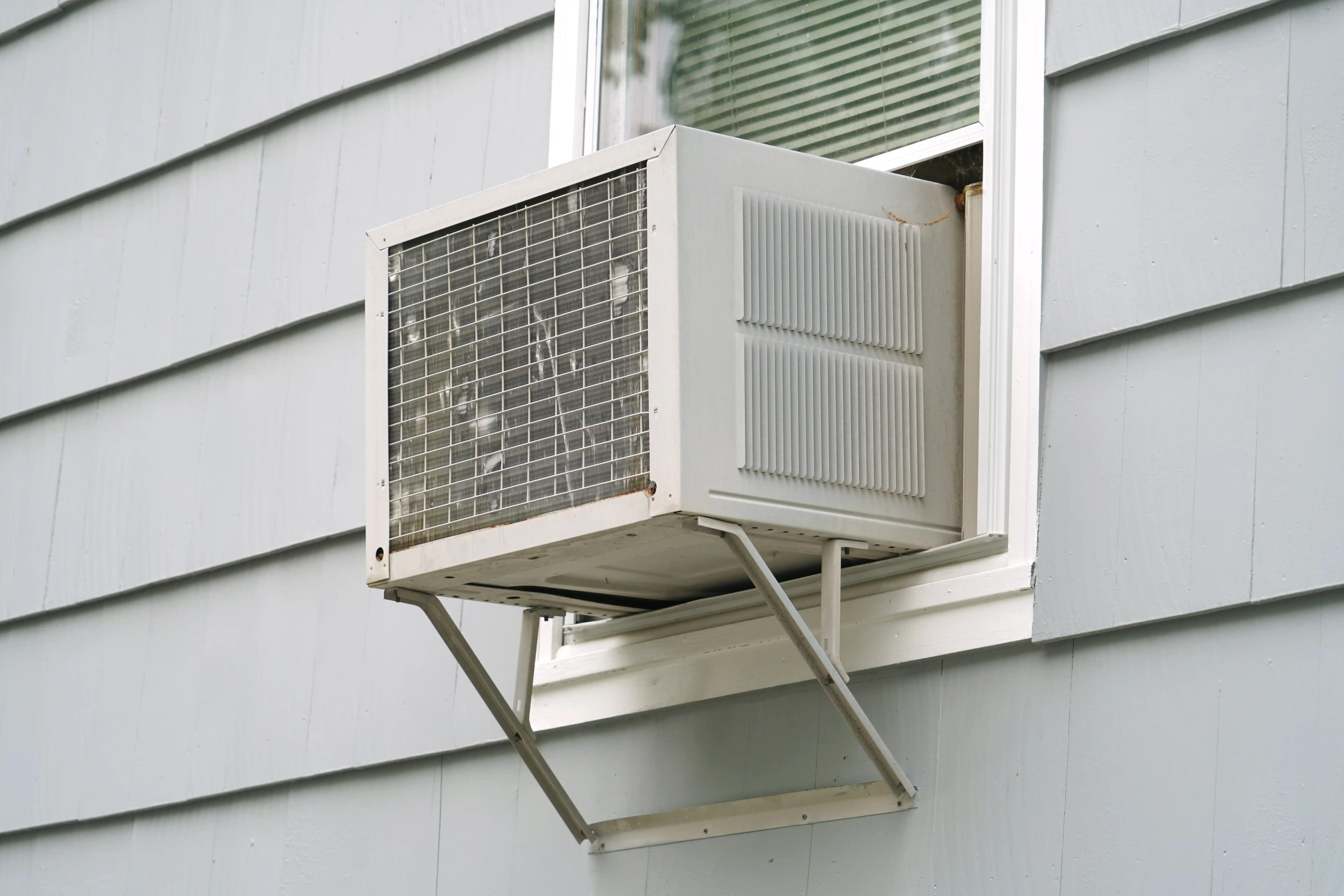
How to Size a Window Air Conditioner Quickly
The fastest rule of thumb for a window AC is about 20 BTU per square foot, then adjust for room conditions. Higher ceilings, direct sun, kitchens, weak insulation, and hot climates all push the required BTU upward. Bedrooms, shaded rooms, and well-insulated spaces can stay closer to the baseline. The calculator above handles those adjustments automatically — use this guide for fast planning and the calculator for the actual buying decision.
ASHRAE's standard sizing guideline backs this up: roughly 20 BTU per square foot for rooms with standard 8-9 foot ceilings, +10% for south or west-facing rooms with afternoon sun, -10% for shaded north-facing rooms. ENERGY STAR's sizing guidance adds about 4,000 BTU for kitchens and 600 BTU per additional regular occupant above two people. Never rely on square footage alone — adjustments matter more than people think.
Window AC BTU Size Chart
| Window AC size | Typical room size | Common search match |
|---|---|---|
| 5,000 BTU | 100-150 sq ft | 5000 BTU air conditioner room size |
| 6,000 BTU | 150-250 sq ft | 6000 BTU air conditioner room size |
| 7,000 BTU | 250-300 sq ft | 7000 BTU AC room size |
| 8,000 BTU | 300-350 sq ft | 8000 BTU air conditioner room size |
| 10,000 BTU | 400-450 sq ft | 10000 BTU air conditioner room size |
| 12,000 BTU | 450-550 sq ft | How many square feet will 12,000 BTU cool |
| 14,000 BTU | 550-700 sq ft | Window air conditioner for 600 square feet |
| 24,000 BTU | 1,000-1,400 sq ft | What size room will a 24000 BTU air conditioner cool |
Common room examples to translate the chart into real-world spaces:
| Room example | Typical window AC size |
|---|---|
| 12x12 room (144 sq ft) | 5,000 BTU |
| 250 sq ft room | 6,000-7,000 BTU |
| 300 sq ft room | 7,000-8,000 BTU |
| 500 sq ft room | 10,000-12,000 BTU |
| 600 sq ft room | 12,000-14,000 BTU |
| 0.75 ton window AC | About 9,000 BTU, often around 350-400 sq ft |
A 0.75 ton window AC is roughly 9,000 BTU because 1 ton of cooling equals 12,000 BTU.
Window AC BTU Rules That Matter Most
Most window AC sizing mistakes happen because people rely on square footage alone. In practice, the biggest adjustments come from ceiling height, solar gain, insulation, room type, and the number of windows. A 300 square foot bedroom and a 300 square foot kitchen do not need the same unit. Same square footage, different load — the kitchen needs roughly 4,000 more BTU just for appliance heat.
Add BTU when
- Ceilings are above 8 feet
- The room gets strong afternoon sun
- The space is a kitchen or busy living room
- Insulation or windows are older and leaky
- You live in a hotter climate
- Regular occupancy is more than two people
Step beyond a window AC when
- The room is over about 700 square feet
- The layout is long, open, or split into multiple areas
- You need quiet, all-day cooling in a main living area
- The electrical requirement moves into large 230V equipment
- You need whole-home or multi-room cooling
Properly sized window ACs maintain consistent temperature and humidity, reduce energy costs by 20-30%, and last 50% longer than oversized units. Right-sizing is the single biggest decision in window AC purchasing — bigger is not better.
Window Fit, Electrical, and Installation Checks
A correctly sized unit still fails if it does not fit the opening or does not match the electrical setup. Before buying, confirm the exact minimum and maximum window width on the specification sheet, the required opening height, and the unit weight your sill must support.
- Open the lower sash and measure the clear width between the inside tracks.
- Measure the clear opening height from the sill to the raised lower sash.
- Check the minimum and maximum width on the AC specification sheet, not just the marketing title.
- Confirm the sill and frame can support the installed weight.
- Make sure the window type is compatible. Standard double-hung windows are easiest; casement windows usually need a different solution.
Many window AC units fit openings about 23-36 inches wide and need at least 14-16 inches of opening height, but exact dimensions vary by model. Install with a slight downward tilt outside for drainage. Seal gaps with weatherstripping to prevent warm air infiltration.
Important Electrical Checks
- Up to about 12,000 BTU: usually 115V, though larger 115V models may still need a dedicated 20-amp circuit
- 14,000 BTU and above: often 230V, depending on the model
- Never use extension cords: the current draw is too high for that shortcut
- Seal around the unit: fit and weatherstripping matter for comfort and efficiency
Cost: Unit Price, Installation, and Operating
Window AC remains one of the most affordable cooling options. Total installed cost runs $300-$1,100 for most residential purchases. Operating cost varies sharply by BTU size and local electric rates.
| Unit Size | Unit Cost | Monthly Operating Cost | Best For |
|---|---|---|---|
| 5,000-6,000 BTU | $150-$300 | $19-$30 | Small bedrooms, offices |
| 8,000 BTU | $250-$430 | $30-$40 | Standard bedrooms |
| 10,000 BTU | $280-$530 | $40-$50 | Large bedrooms, small living rooms |
| 12,000 BTU | $300-$600 | $50-$60 | Medium living rooms |
| 14,000-18,000 BTU | $400-$800 | $60-$70+ | Large living spaces, open plans |
Monthly operating cost based on 8 hours/day at $0.13/kWh (national average). ENERGY STAR models reduce running cost by 10-15%. Each degree of cooler thermostat setting adds 3-5% to your bill.
Window AC vs Portable AC vs Mini-Split
Window AC is one of three popular single-room cooling options. The choice usually comes down to upfront cost, efficiency, and how long you plan to live with the system. Quick comparison:
| System | Installed Cost | Efficiency (EER/SEER) | Monthly Operating Cost |
|---|---|---|---|
| Window AC | $300-$1,100 | 8-15 EER | $19-$55 |
| Portable AC | $300-$700 | 8-12 EER | $29-$50 |
| Single-zone Mini-split | $2,000-$10,500 | 20-35+ SEER | $17-$72 |
Mini-splits use roughly 50-60% less electricity than window ACs and 65-75% less than portables for the same cooling. Portable ACs typically cost 30-50% more to operate than window units due to design inefficiencies and air leakage. A DIY-installed mini-split breaks even with a window AC in roughly 3-4 years on operating cost; a professionally installed mini-split takes 7-8 years to break even but adds home value and provides heating too. For most renters or short-term homeowners, a properly sized window AC remains the most cost-effective single-room cooling solution. For a side-by-side comparison, see our mini-split sizing calculator. Note: the federal 25C HVAC tax credit expired December 31, 2025 — new mini-split installs no longer qualify for the federal $2,000 credit. Check current state and utility rebate programs.
Energy Efficiency and Upgrade Guidance
After sizing, efficiency is the next filter. Window ACs typically range 8.0-12.5 EER, with the most efficient models exceeding 13.0 EER. Look for ENERGY STAR certification (minimum 10 EER) and features that let the unit run steadily instead of cycling on and off. A properly sized efficient window AC is usually cheaper to run than an oversized bargain unit.
Lower operating cost
- Choose ENERGY STAR where possible
- Clean filters monthly during cooling season
- Keep the thermostat realistic (78°F is the EPA recommendation)
- Seal gaps around the installation
- Use a programmable timer to avoid cooling empty rooms
Consider replacing when
- The unit is over 10 years old
- It runs constantly but still struggles
- Repairs are becoming frequent
- The room load has changed since the last purchase
- A 30%+ efficiency upgrade would pay back in under 4 years
Final Sizing Tips
Selecting the right window AC size is essential for maintaining comfort while controlling energy costs. The calculator above provides personalized recommendations based on your specific room characteristics. Remember that proper installation and maintenance are just as important as choosing the correct BTU capacity.
Purchase before peak summer heat arrives (April-May) for better selection and pricing. Many retailers offer pre-season sales with 10-20% savings vs peak summer prices. Early installation lets you test the unit before you need it. For rooms over 700 square feet, complex layouts, or whole-home cooling needs, step up to a multi-zone mini-split or run a full residential Manual J load calculation first.
Frequently Asked Questions About Window AC Sizing
What size window AC do I need for a 12x12 room?
A 12x12 room equals 144 square feet. Using the standard 20 BTU per square foot calculation, you would need approximately 2,880 BTU as a baseline. However, most manufacturers do not make units this small, so a 5,000 BTU window AC would be appropriate for a 12x12 bedroom with standard 8-foot ceilings and moderate sun exposure. If the room faces south or has poor insulation, consider a 6,000 BTU unit.
How many BTU do I need for 500 square feet?
For a 500 square foot space, the baseline calculation (500 × 20 BTU) suggests 10,000 BTU. However, you should choose between 10,000-12,000 BTU depending on factors like ceiling height, sun exposure, and room usage. A living room with multiple occupants needs 12,000 BTU, while a bedroom might only need 10,000 BTU. Hot climates or rooms with many windows should lean toward 12,000 BTU.
Can a window AC be too big for a room?
Yes, an oversized window AC causes several problems. It cools the room too quickly and shuts off before removing humidity, leaving the space cold but clammy. This short-cycling increases wear on components, reduces unit lifespan, and uses more energy due to frequent starts and stops. An AC that is 20-30% oversized might be acceptable, but anything larger will compromise comfort and efficiency.
What happens if my window AC is too small?
An undersized window AC runs continuously trying to reach the set temperature, never cycling off for rest. This constant operation increases electricity bills by 30-50%, wears out the compressor prematurely, and fails to adequately cool during peak heat. The unit may provide some cooling near the AC but leaves far corners warm. If your AC runs nonstop on moderate days, it is likely undersized.
How do I calculate BTU for a window air conditioner?
Start with the base calculation: Room square footage × 20 BTU. Then adjust: Add 10% for sunny rooms, subtract 10% for shady rooms. Add 4,000 BTU for kitchens, 600 BTU per person beyond two occupants, and 10% for poor insulation. For ceiling heights above 8 feet, add 10% per extra foot. Our calculator above automates these calculations.
What size window AC for a bedroom?
Bedroom window AC sizing depends on room dimensions. Small bedrooms (100-150 sq ft) need 5,000 BTU. Standard bedrooms (150-250 sq ft) require 6,000 BTU. Large bedrooms (250-350 sq ft) need 7,000-8,000 BTU. Master bedrooms (350-500 sq ft) require 9,000-10,000 BTU. Choose quieter models with sleep modes for bedrooms.
What size window AC for a living room?
Living rooms typically need larger window AC units due to higher occupancy and activity levels. Small living rooms (250-350 sq ft) need 8,000 BTU. Medium living rooms (350-500 sq ft) require 10,000-12,000 BTU. Large living rooms (500-700 sq ft) need 14,000 BTU. Open concept spaces may require 18,000+ BTU or multiple units. Add 600 BTU per regular occupant beyond two people.
Do I need 110V or 220V for a window AC?
Most window AC units up to 12,000 BTU run on standard 115V (110-120V) household outlets with 15-amp circuits. Units from 10,000-14,000 BTU may require a dedicated 20-amp circuit on 115V. Window ACs above 15,000 BTU typically need 230V (220-240V) outlets with special plugs. Check the unit electrical specifications before purchasing. Never use extension cords.
How much does a window AC cost installed?
Window AC unit cost ranges from $150 to $800 depending on BTU size, brand, efficiency, and features. Smaller 5,000-8,000 BTU units run $150-$530, while larger 12,000-18,000 BTU units cost $300-$800. Professional installation adds $138-$526, with $314 typical. Total installed cost runs $300-$1,100 for most residential window AC purchases.
How much does it cost to run a window AC?
Operating costs depend on unit size, efficiency, usage hours, and local electricity rates. A 10,000 BTU window AC running 8 hours daily at $0.13 per kWh costs approximately $40-$50 monthly. Smaller 6,000 BTU units cost $25-$30 monthly, while larger 14,000 BTU units run $60-$70. Window ACs cost $19-$55/month on average. ENERGY STAR models reduce costs by 10-15%.
Window AC vs portable AC vs mini-split: which is most efficient?
Mini-splits are the clear efficiency winner — typically using 50-60% less electricity than window ACs and 65-75% less than portable units for the same cooling. Window ACs max around 15 EER. Portable units rarely exceed 12 EER. Mini-splits routinely hit SEER 20-35+. However, window ACs cost $300-$1,100 installed vs $2,000-$10,500 for a single-zone mini-split.
What is the most energy efficient window AC size?
The most energy-efficient window AC is one properly sized for your room. Units between 8,000-12,000 BTU typically offer the best efficiency ratings (EER 11-12.5) due to optimized compressor designs. Look for ENERGY STAR certified models with EER above 10. The most efficient window ACs exceed 13.0 EER. Features like inverter technology, programmable thermostats, and eco modes improve efficiency further.