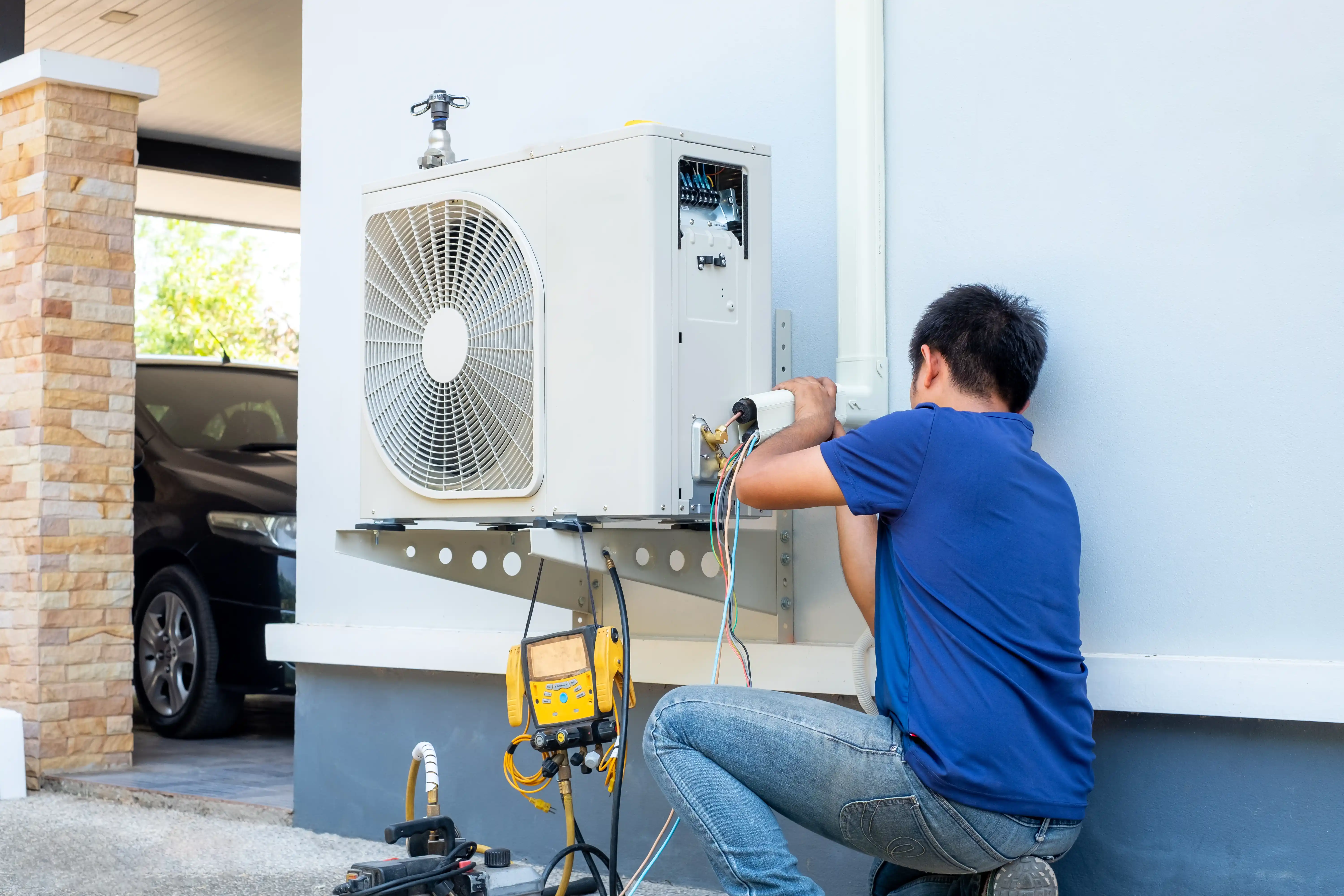
What Size AC Do I Need? Start with Tonnage
The short answer: most US homes need 2 to 5 tons of AC, sized to your square footage, climate, and how much moisture the air carries. A 1,500 sq ft house in a mixed climate usually lands at 2.5 tons. A 2,500 sq ft house in Houston might need 4 tons. The calculator above runs the math for your specific inputs, but knowing what a ton actually means helps you sanity check the result.
One ton of air conditioning equals 12,000 BTU per hour of cooling. The unit comes from 19th century ice math (the amount of heat needed to melt one ton of ice in 24 hours) and stuck around even though nobody buys ice for cooling anymore. Residential central AC comes in half ton steps from 1.5 tons (18,000 BTU) up to 5 tons (60,000 BTU). Bigger homes usually need two separate systems.
The catch is that nameplate tonnage is rated at 95°F outdoor and 80°F indoor with 50 percent humidity. The unit you bolt to your house produces less than nameplate on a 105°F day in Phoenix and more on a 75°F day in San Diego. Real world output drifts 5 to 15 percent from the rating sticker, which is why sizing the system right matters more than buying a bigger one.
How to Size a Heating and Air Conditioning System
Sizing a heating and air conditioning system is two separate math problems handled by one piece of equipment (a heat pump) or two coordinated pieces (a furnace plus AC). Cooling sizing starts with sensible heat gain plus latent moisture removal, both expressed in BTU per hour. Heating sizing starts with heat loss through walls, attic, windows, and infiltration at your winter design temperature, also BTU per hour.
The selector at the top of this page lets you switch between cooling only, heating only, or both. Pick heating plus cooling and the result panel will show you AC tonnage AND the matching gas furnace input BTU, heat pump tonnage, or electric resistance kW for your heating side. The breakdown table further down lists every input that drives the numbers (climate zone, insulation, ceiling height, windows, sun exposure, occupants) so you can sanity check a contractor's recommendation against your actual house.
A correctly sized heating and cooling system runs in 15 to 20 minute cycles on a design day, holds indoor humidity below 55 percent, and reaches setpoint without short cycling or running flat out for hours. The rest of this page walks through the numbers behind each input so the calculator's output is not a black box.
AC Tonnage by Square Footage and Climate Zone
The chart below is a starting point, not a final number. It assumes average insulation, 8 foot ceilings, normal window area (about 15 percent of floor area), and two to four occupants. Humid zones run higher because the unit has to remove moisture along with heat. Dry zones run lower because the same BTU does more useful temperature work when there is no latent load fighting it.
| Home Size | Zone 1A / 2A (Hot Humid) | Zone 1B / 2B (Hot Dry) | Zone 3A / 4A (Mixed Humid) | Zone 3B / 4B (Mixed Dry) | Zone 5 to 7 (Cold) |
|---|---|---|---|---|---|
| 1,000 sq ft | 2.0 ton | 1.5 ton | 1.5 ton | 1.5 ton | 1.5 ton |
| 1,500 sq ft | 3.0 ton | 2.5 ton | 2.5 ton | 2.0 ton | 2.0 ton |
| 2,000 sq ft | 4.0 ton | 3.0 ton | 3.0 ton | 2.5 ton | 2.5 ton |
| 2,500 sq ft | 4.5 ton | 3.5 ton | 3.5 ton | 3.0 ton | 3.0 ton |
| 3,000 sq ft | 5.0 ton | 4.0 ton | 4.0 ton | 3.5 ton | 3.0 ton |
| 3,500 sq ft | 5.0 ton | 4.5 ton | 4.5 ton | 4.0 ton | 3.5 ton |
| 4,000 sq ft | 5.0 + 2.0 ton split | 5.0 ton | 5.0 ton | 4.5 ton | 4.0 ton |
Cross check this number against your IECC zone. If you do not know it, use the climate zones guide or look up your county on the DOE map. Houston is 2A. Phoenix is 2B. Atlanta is 3A. Denver is 5B. Minneapolis is 6A. These five cities span almost the full sizing range in the table above.
The Phoenix vs Houston comparison is the cleanest example. Both cities hit 100°F regularly. A 2,000 square foot house in Phoenix needs 3 tons. The same house in Houston needs 4 tons. The difference is humidity. Phoenix design dew point is 55°F. Houston design dew point is 76°F. The Houston unit has to condense out roughly a gallon of water per hour while it cools, and that work shows up on the BTU sheet.
AC Tonnage Per Square Foot: The Rule of Thumb
The quick rule most people search for is 1 ton of AC per 400 to 600 square feet. Divide your square footage by 500 for a middle-ground estimate: a 2,000 square foot home lands at about 4 tons on that math, though a right-sized system in a mild or dry climate often comes in lower at 3 to 3.5 tons. The 500 figure is a hot-humid-climate number. In a dry climate like Phoenix or Denver, use 600 square feet per ton instead, which drops the same house to roughly 3.3 tons.
Put another way, that is about 20 to 30 BTU per square foot for cooling (1 ton equals 12,000 BTU). Sunrooms, kitchens, and poorly insulated rooms push toward the high end. Shaded, tightly built rooms sit at the low end. Treat any per-square-foot rule as a sanity check, not a final answer, because two identical-size homes can differ by a full ton once climate, insulation, windows, and ceiling height are counted. The calculator above does that full accounting for you.
Commercial AC Tonnage Is Sized Differently
Commercial spaces do not follow the residential 400 to 600 square feet per ton rule. A typical office runs closer to 300 to 350 square feet per ton because of higher occupancy, lighting, and equipment heat. Restaurants, kitchens, and server rooms can drop to 100 to 200 square feet per ton once you add cooking loads or dense electronics. A 3,000 square foot office often needs 8.5 to 10 tons, roughly double what the same footprint would need as a house.
This calculator is built for residential sizing. For commercial work, a proper cooling load has to count plug loads, ventilation air, and occupancy schedules that residential Manual J does not weigh the same way. Use the residential result as a floor, then add for the loads above, and have a mechanical engineer confirm anything above 5 tons or with heavy internal gains.
Sensible vs Latent Load: Why Your AC Has Two Jobs
Cooling load splits into two parts. Sensible load is temperature work, the BTU needed to drop air from 78°F to 75°F. Latent load is moisture work, the BTU needed to condense water vapor out of the air. A 3 ton AC in a dry zone might use 85 percent of its capacity on sensible. The same 3 ton AC in Florida might split 65 percent sensible, 35 percent latent.
That ratio is called SHR, sensible heat ratio. It is printed on every AC unit performance sheet. Higher SHR (0.80 to 0.85) means the unit favors temperature. Lower SHR (0.70 to 0.75) means it pulls more moisture per BTU. A standard single stage unit usually lands around 0.78. A two stage on low fire drops to 0.72. A variable speed (inverter) at 40 percent capacity can hit 0.65, which is why those units hold humidity at 50 percent in a sticky climate when standard units leave the house at 60.
Practical translation. If you live in zone 1A, 2A, 3A, or 4A and your house feels clammy at 74°F, the unit is oversized, has too high an SHR, or both. Dropping a half ton and switching to two stage usually fixes it. If you live in zone 2B, 3B, or 4B and the unit hits setpoint but the air feels dry and dusty, that is normal for high SHR equipment in a dry climate. No fix needed.
What Happens When Your AC Is the Wrong Size
Oversized is the more common failure. A 4 ton on a house that needs 3 tons short cycles. It blasts cold air for 6 minutes, hits the thermostat setpoint, and shuts off before the evaporator coil pulls real humidity out of the air. The house ends up at 74°F and 62 percent humidity, which feels worse than 78°F and 45 percent humidity. Indoor air quality drops, compressor cycles double, and the unit dies 5 to 7 years early.
Undersized is rarer but worse when it happens. A 2 ton on a house that needs 3 tons runs continuously on a 95°F day, never reaches setpoint, and the compressor runs hot for hours. Energy bills spike 30 to 50 percent. The compressor usually fails in years 4 to 6 instead of 12 to 15. Bedrooms upstairs stay at 82°F while the thermostat downstairs reads 76°F.
For a deeper look at the cycle length and humidity math, the oversized HVAC system problems article walks through real measured data from short cycling units. The single best diagnostic you have is timing one cycle on a hot afternoon. Under 10 minutes is oversized. 15 to 20 minutes is correct. Continuous for an hour with no setpoint reach is undersized.
Single Stage, Two Stage, or Variable Speed: Which AC Type for Your Climate
Single stage runs at 100 percent or 0 percent. It is the cheapest install, usually $4,500 to $7,000 for a 3 ton condenser plus coil and labor. It works fine in dry climates with mild summers (zone 3B, 4B, 5B, 6B) where humidity is not a daily fight and short cycles do not cause comfort issues. It is the wrong call for any humid zone.
Two stage runs at roughly 65 percent on low fire and 100 percent on high fire. Install cost is $6,500 to $9,500 for the same 3 ton. The low fire stage runs longer and pulls more humidity, which is what mixed climate homes (zone 3A, 4A, 5A) need. It is the sweet spot for most of the eastern US and the Pacific Northwest east of the Cascades.
Variable speed (inverter) modulates anywhere from 30 to 100 percent continuously. Install cost is $8,500 to $13,000 for a 3 ton. In a humid climate (1A, 2A) or a very tight high performance home, it can run all afternoon at 35 percent capacity, hold the house at 50 percent humidity, and never short cycle. Energy use drops 20 to 35 percent vs single stage in the same house. Payback is 6 to 10 years on utility bills, longer in mild climates where the unit barely runs.
| Stage Type | Install Cost (3 ton) | Best Climate | Typical SHR |
|---|---|---|---|
| Single stage | $4,500 to $7,000 | Dry zones 3B, 4B, 5B, 6B | 0.78 |
| Two stage | $6,500 to $9,500 | Mixed 3A, 4A, 5A | 0.72 to 0.75 |
| Variable speed | $8,500 to $13,000 | Humid 1A, 2A or tight homes | 0.65 to 0.70 |
How to Verify a Contractor's AC Tonnage Recommendation
Most replacement quotes match the existing unit ton for ton. That is the single biggest reason oversized AC stays oversized for 30 years. When a contractor walks the house, ask these four questions before signing anything.
- Did you run a Manual J? ACCA Manual J is the residential cooling load standard. A real Manual J takes 30 to 60 minutes and produces a printed report with room by room loads, window areas, and infiltration assumptions. If the answer is "I used a rule of thumb" or "I matched the old unit," that is the red flag.
- What is the design temperature you used? Should be the ASHRAE 1 percent dry bulb for your zip code. For Atlanta that is 92°F. For Phoenix it is 108°F. For Boston it is 88°F. If they used 100°F for everywhere, the calculation is generic.
- What is the design grain count or dew point? This is the latent load input. For Houston it should be around 110 grains. For Denver it should be around 50 grains. A contractor who cannot answer this is using a cooling only sizing tool that ignores humidity.
- Can I see the room by room load printout? A real Manual J shows bedrooms, living room, kitchen with separate sensible and latent loads. If the answer is one number for the whole house, the calculation skipped the duct sizing step (Manual D) and the airflow per room will not match the loads.
If you want to run the numbers yourself before the contractor visit, the residential load calculator walks through the same Manual J inputs. For room by room airflow, the CFM calculation guide covers the duct sizing piece.
Frequently Asked Questions
How many tons of AC do I need for 2,000 square feet?
Most 2,000 square foot homes need 3 to 4 tons of cooling. In a humid zone like Houston (2A) you size toward 4 tons because the latent load is heavy. In a dry zone like Phoenix (2B) or Las Vegas (3B) the same house only needs about 3 tons because there is almost no moisture to remove. Insulation, sun exposure, window area, and ceiling height all shift the number by half a ton in either direction.
Is it better to oversize or undersize an AC?
Neither. An oversized AC short cycles, leaves the house clammy, and wears the compressor out years early. An undersized AC runs nonstop on a 95°F day, never reaches setpoint, and burns through electricity. The right size runs for 15 to 20 minute cycles on a design day with the indoor humidity below 55 percent. That is the cycle length you are aiming for.
How much AC tonnage do I need per square foot?
The common rule is 1 ton per 400 to 600 square feet, or about 20 to 30 BTU per square foot. Divide your square footage by 500 for a middle estimate and by 600 in a dry climate. A 2,000 square foot home lands around 3.3 to 4 tons depending on climate and insulation. Treat this as a sanity check only, since climate, windows, and ceiling height can shift the real number by a full ton.
How do I calculate commercial AC tonnage?
Commercial spaces need more cooling per square foot than homes. A typical office runs 300 to 350 square feet per ton, and restaurants or server rooms can drop to 100 to 200 square feet per ton once cooking and equipment heat are counted. A 3,000 square foot office often needs 8.5 to 10 tons. Commercial sizing must include plug loads, ventilation air, and occupancy, so have a mechanical engineer confirm anything above 5 tons.
What does 1 ton of AC actually mean?
One ton of air conditioning equals 12,000 BTU per hour of cooling. The name comes from the rate at which one ton of ice melts in 24 hours. Residential central AC units range from 1.5 tons (18,000 BTU) up to 5 tons (60,000 BTU) in half ton steps. Anything bigger usually requires two separate systems.
How is AC tonnage different from BTU?
They are the same measurement in different units. Tonnage is just BTU divided by 12,000. A 36,000 BTU AC is a 3 ton unit. Window and portable units are usually labeled in BTU. Central AC, mini splits over 18,000 BTU, and heat pumps are usually labeled in tons.
Why does climate zone change AC size more than I expected?
Two homes the same size can need a full ton of difference between Minneapolis and Miami. Hot humid zones add latent load (moisture removal) on top of sensible load (temperature). A 2,400 square foot home in zone 2A might need 4 tons. The same home in zone 5A might only need 3 tons. Humidity is the variable people forget.
Do I need a Manual J to know what size AC I need?
For a final equipment order, yes. A calculator like this one gets you within half a ton, which is enough to evaluate contractor quotes. But before you sign off on the unit, a proper Manual J with your actual window areas, insulation R values, and duct losses is what catches the difference between a 3 ton and a 3.5 ton install. Most reputable HVAC contractors will run one and show you the printout.
Should I get a single stage, two stage, or variable speed AC?
In a dry zone with mild summers, a single stage is fine and saves money. In a mixed humidity zone (3A, 4A, 5A), two stage is the sweet spot because it runs longer on low and pulls more humidity out. In a humid zone (1A, 2A) or a very tight high performance home, variable speed (inverter) is worth the extra $1,500 to $3,000 because it can run at 30 percent capacity all day and hold humidity at 50 percent.
Can I just match the size of my old AC?
Usually no. The old unit was probably oversized to begin with (most installs in the 1990s and 2000s were guessed at 1 ton per 500 to 600 square feet). If you have added insulation, swapped windows, or sealed ducts, the new load is lower. Replacing a 4 ton with a 4 ton when the house actually needs 3 tons locks in the same humidity problems for another 15 years.
What is SHR and why does my contractor mention it?
SHR is sensible heat ratio. It tells you what fraction of an AC unit's capacity goes to lowering temperature versus removing moisture. A unit rated SHR 0.80 spends 80 percent of its capacity on temperature and 20 percent on humidity. In a humid zone you want lower SHR equipment (0.70 to 0.75). In a dry zone higher SHR (0.80 to 0.85) is fine because there is no moisture to pull.
How long should my AC run on a hot day?
A correctly sized AC runs in 15 to 20 minute cycles on a design temperature day (the hottest 1 percent of the year for your zip code). If it runs 5 to 10 minute cycles and shuts off, it is oversized. If it runs continuously for hours and the house still creeps up past setpoint, it is undersized or the ductwork is restricted. Cycle length is the cheapest diagnostic you have.